Tuesday, October 27, 2009

Making the veg pledge


Let me make a disclaimer: I am not here to try and convert anyone or ruffle any feathers. I am a new-found vegetarian (about 5 months) with a new outlook on life and I feel it's important for me to share some of these ideas I have adopted. That is all.

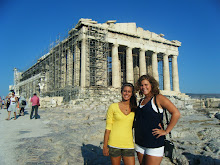
First, becoming a vegetarian was a sort of spur of the moment decision for me. While in Greece this summer, my sister convinced me to go green after seeing countless butcher shops that we literally could not bring our selves to enter because of what we saw. Now, she is 16 and has been living the veggie life for a little over two years, so that experience only affirmed her beliefs. Me on the other hand, I was semi-oblivious to things of that nature, so it was more shocking than anything. A few days later I thought, what the heck, let's try this out and see how it goes. I couldn't be more happy with my choice.

It's true, health reasons did play a semi-important factor in my decision, but probably the single biggest factor contributing to my new lifestyle is that of animal cruelty. Like I said before, I'm not trying to convert anyone, but I would like to share some facts and information --take them for what they're worth.

A lot of people eat meat or fish, but rarely do they know where it comes from.

Take, for example, chicken:

Did you know that chickens are given so many steroids that their bones, specifically their legs, can no longer support them and they break? Or that their organs simply cannot take it anymore and they quit functioning all together? Talk about cruel.

According to GoVeg, "Animals on today's factory farms have no legal protection from cruelty that would be illegal if it were inflicted on dogs or cats: neglect, mutilation, genetic manipulation, and drug regimens that cause chronic pain, transport through all weather extremes, and gruesome and violent slaughter. Yet farmed animals are no less intelligent or capable of feeling pain than are the dogs or cats we cherish as companions."

Just something to think about.

Also check out Kentucky Fried Cruelty.

Sunday, October 25, 2009

My classmates Clifton and Glenn spoke about the pros and cons of being "self-made" or of one day being their own boss. While I do believe that there are benefits to being one's own boss, I agree with Glenn when he says that "we need each other."

As writers, we are always encouraged to make ourselves stand out from the rest with our writing style, or, as mentioned in some of my previous posts, to find our "voice" as journalists. Of course, this is important to us as journalists, however with the hundreds and thousands of writers out there, it is nearly impossible not to blend in at some point in time, making self- publication not impossible, but very difficult.

How are we to distinguish the reputable writers from, let's say, blogger Joe Schmoe? This is where the different agencies come in. Even Brent Cunningham, in his article "How jounalism can regain its relevance," says that journalism is not just a hobby you can pick up or a side job to another career. Not just anyone can write an article, book, etc. and call themselves journalists. We need the agencies to weed out the skill and we should not just rely on someone to "discover" us.

Don't get me wrong, aspirations and goals are extremely important to have, and it is admirable for someone to have such aspirations in a time where it seems that there is little hope for our profession. However, we as journalists need to stick together so that in the future it isn't so extreme to have a goal of being a self-published writer.

Friday, October 23, 2009

Journalism: getting back in the game

Brent Cunningham's article "How Journalism can Regain its Relevance" raises some very important issues regarding the state of modern journalism, or lack thereof.

Cunningham suggests that journalists shift the focus off of "breaking, event-driven news" to more " sustained coverage of ideas and-- crucially --solutions." This couldn't hurt. Yes, I suppose it is important to know each breaking news story occurring in one's community, but if we focus on more pressing issues, we could possibly, according to Cunningham, force an issue of consequence out in the open and onto the national agenda, forcing leaders and politicians to confront these issues head-on and uncover possible solutions.

However, Cunningham suggests that journalists not simply be record-keepers, but to include their ideas and opinions that could very well differ from those of their leaders and superiors. While this is all well and good, this so-called "record-keeping" still holds a valid place in modern journalism. As my classmate Wade Hooks said, it is crucial that readers take on the responsibility of being critical thinkers. The job of the journalist is to provide readers with the facts and let them do with those facts what they will. We are not here to spoon-feed readers the information they want to hear and share with them ideas that we know they will agree with. There is a reason that there is an "editorial" section and not simply a "news and facts" section.

There is one point that Cunningham makes that I could not agree with more: citizen-journalism could never fully replace professional journalism. Journalism is a career, not a hobby. I am a journalist because I am passionate about journalism, I am committed to it and because I do it well. There is no way that I could simply be a reporter as a side job to some other career. Citizen-journalism is relevant, there is no doubt about that, but professional journalism is also, if not more, relevant. It is important to have people out there who are able to gather the facts, then report on them and report on the well.

Sure, anyone can keep a blog or create a Twitter account, but it takes a true journalist to knowledgeably and effectively report the news.

Sunday, October 18, 2009

You sue me, I sue you

This is in regard to a post by my classmate, Kathleen Monk, about the state of America "as we know it." In her post, Kathleen talks about many potential things that cause a lawsuit and absurd reasons as to why a person would sue another person.

I have to say, I completely agree with Kathleen. These days, especially with the economy being in the state that it is, people will sue for anything in order to make a quick buck. Take for example the teenagers suing McDonald's for making them fat. Is it not common knowledge that fast food is bad for your health? This is what our society has come to: suing a fast food company because you just simply could not resist their delicious hamburgers and golden french fries. Take some responsibility for your actions, people.

Kathleen says in her post that someone could potentially be sued if they attempt to perform CPR on a person and that person happens to not make it through. Honestly, if someone attempted to save one of my loved one's life by performing CPR, I would be grateful for their kindness and, although it would be unfortunate if my loved one didn't make it, there is no way I could sue someone for trying to save a life -- it just wouldn't be right.

Saturday, October 17, 2009

A good sense of style

I realize that this may be going against the assignment, but I don't really know of anyone whose voice I would want to copy, and therefore I will not be copying a fellow writer's style for this post. Philip Agre says to "Choose someone you identify with and copy their voice -- not their exact words but their style -- until you get comfortable"-- that's just it, until you get comfortable. Personally, I am comfortable with my own voice. As Agre suggests, I laugh at my mistakes, I respond to others' discussions and I come up with alternate ways to say what I need to say. I don't think that it's necessary for me to copy someone else's voice because, although I may be relatively new to the professional writing world, I am comfortable with what I am saying and how I am saying it.

However, I do agree with many of the ideas that Agre suggests in his article "Find Your Voice: Writing for a Webzine." Agre says "Don't wait for your public voice to grow automatically, because it won't. Build it. Consciously choose to start out easy, get comfortable, and ramp up." Blogging is an excellent way to do this. With a blog, you can gradually build your voice with every post; maybe start slow than work your way up to more intricate and in-depth posts about more complicated topics. I can definitely relate this to my own blog. At first, I was hesitant about what to post, however, now I feel more comfortable with blogging and with my voice in my own blog.

Friday, October 16, 2009

When one door closes...

By now, it's clear that the new digital news environment has created opportunities that were otherwise not available to "normal" people. We are able to do things that, with the legacy system of journalism, we could never do before.

In the lecture notes for this week, Dr. Tracy discusses coverage of the London subway bombings of 2005. Survivors of this horrific event took video from their cell phones, and the clips were almost instantly broadcast to audiences around the globe giving them an up close and personal view of the tragic incident while remaining safely in the comfort of their own living room. This does not necessarily make the survivors of the bombings "journalists," however, it does prove just how advanced journalistic practices are becoming.

For now, we still have our regular newspapers, however few there may be left, which are still reporting the daily happenings of local communities and the major events affecting the global community. These newspapers still have reporters who go out and report on the news, editors who still edit the news and publishers who still publish the news -- these practices haven't changed... yet. Despite this, many people still feel that print journalism is dying, and whether that may or may not be true, there are emergent practices that are revolutionizing journalism.

Many of my classmates have discussed YouTube in their posts, and I feel that I must jump on that bandwagon. YouTube, specifically, hasn't revolutionized journalism, but the idea of including video clips in news articles or blogs, becoming an Internet celebrity or posting video coverage of a particularly important event were never even considered until recent years. Now, reporters of online news articles can include video clips to enhance their story or expand on the issue at hand. Many news organizations also use Twitter as a way of reporting before the full story is actually complete. At emyou! The Magazine where I work, we have talked about encouraging writers to create a Twitter account so that we can quickly and conveniently post updates about potential stories, then report on them later. This journalistic practice is completely new and is actually quite beneficial. It allows time for reporters, after posting a quick 140 character or less blurb about a lead, to keep audiences updated while still getting the full and complete story and reporting on it later.

What's important is that newspapers and practices that are still relevant today, with their online versions, are adopting the new technologies giving readers the best of both worlds: those who prefer to read print can still do so, and those who prefer to read online versions with links and video clips can do so.

Sunday, October 11, 2009

Huh?

This post is in response to a post by one of my classmates, Wade Hooks, about the general intellect of the American public.

Not only are Americans not being taught about what is important, such as how to save and budget money as Wade mentions, the focus is totally off. Kids in school, even if they were learning the more important things in life, are not focused on the actual learning that could be taking place, but of the grade they will receive when they turn in their assignment. It's not about gaining an understanding of the subjects being taught, it's about memorization, and as soon as that exam passes, most of the information is simply forgotten.

I know that I personally was very concerned about grades in high school, and I would be lying if I said that grades do not bother me anymore now that I am in college, but is that my fault? All throughout our scholastic careers, the concept of "getting good grades" is constantly being hammered into our brains -- good grades equals success, bad grades equals failure. This is not only making learning a chore, but causing more and more Americans to focus on the letter on top of the exam rather than the content of it.